

A Quick Story Of History On Our Doorstep
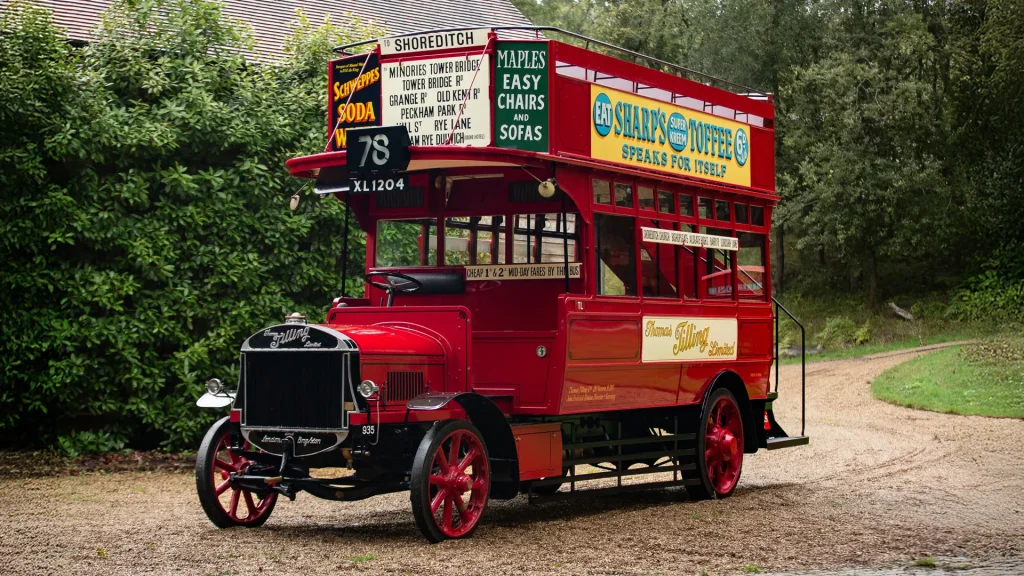
1922 Tilling-Stevens TS3A Petrol / Electric Bus
In the closing years of the 19th century, a young engineer named William Arthur Stevens set his sights on a bold idea: building vehicles for a rapidly changing world. Around 1897, he began experimenting with coach-building, helped in no small part by access to his father’s timber yard. At the time, wood was essential for vehicle manufacture whether horse-drawn or motorised, as vehicle bodies were largely made of wood.
London, meanwhile, was on the move. It’s streets were crowded with omnibuses, mostly horse-drawn. Omnibuses or what we would simply call today buses could carry passengers on one or two levels: the two level versions had an enclosed lower deck and an open-air top deck. Some could carry 30 or more people, clattering through the capital behind teams of horses. On the back of the double decker buses was a small wooden staircase to access the upper floor, potentially a very dangerous climb if you didn’t hang on.
But a technological shift was underway. Petrol-powered buses were beginning to appear, promising greater efficiency but bringing new problems. Chief among them was the gearbox. Early drivers had to wrestle with what’s known as the “crash gearbox”. This required skill and timing to operate. Changing gears wasn’t just a matter of pressing the clutch once, it involved a technique called double clutching: clutch in, out of gear, clutch out, then back in again before selecting the next gear. All this had to be done while carefully matching engine speed to avoid a grinding, jarring mess. Imagine doing that repeatedly in stop-start London traffic, with a full load of impatient passengers behind you. Even worse if you were climbing those stairs to the top deck at the same time.
Stevens believed there had to be a better way.
In 1904, he formed a partnership with Thomas Tilling, a major figure in London transport. Tilling was already deeply invested in horse-drawn operations, with around seven thousand horses under his care. These, along with the vast infrastructure needed to house, feed, and maintain them was enormously costly.
Together, they founded the company that became Tilling-Stevens with it’s manufacturing base in Maidstone. In 1906 Tilling Stevens revealed something remarkable: a petrol-electric bus. Instead of using a conventional gearbox, the petrol engine powered a generator, which in turn supplied electricity to a motor that drove the rear wheels. No batteries, the electric motor needed no gears, just smooth, continuous motion. In effect, it was an early hybrid vehicle being used in London over one hundred years ago.
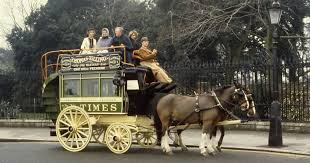
Thomas Tilling ‘Knifeboard’ type horse Bus
These buses started operated in London in the early 1900s, offering a quieter and more manageable driving experience compared to their gearbox-heavy petrol rivals.
Pace of change was striking. While it’s often said that iPhone transformed modern life in under two decades, London’s transport revolution happened just as quick. Between roughly 1905 and 1911, horse-drawn buses rapidly gave way to motorised versions. The shift wasn’t quite as absolute or as fast as sometimes claimed, horses didn’t vanish overnight, but the direction was clear. As for Thomas Tilling and his 7000 horses, by 1911 most had gone and the city’s sights, sounds, and even smells changed dramatically; from horse ‘dodo’ to the oily tang of those early combustion engines.
And where were William Stevens petrol-electric buses built? In Maidstone. The factory was on the west bank of the River Medway, close to the railway bridge leading into Maidstone East station. From this quiet corner of Kent came vehicles that, in many ways, anticipated the hybrid and electric transport solutions we’re rediscovering today.
It’s hard not to wonder: if that early momentum had continued, might our cities have gone electric much sooner?
If you want to hear more Maidstone history stories, why not join one of my walking tours. I’d be very happy to see you.