The Final Quarter: 10 Challenges UK Businesses Must Address to Protect Profitability And Build Long-Term Shareholder Value
I am looking forward to delivering my presentation on Wednesday 2nd December at 80 Churchill Square, Kings Hill, West Malling, Kent, ME19 4YU
“The Final Quarter: 10 Challenges UK Businesses Must Address to Protect Profitability and Build Long-Term Shareholder Value.”
The session will explore the combination of challenges facing UK businesses and, importantly, how business owners and directors can respond by developing a clear, practical roadmap for sustainable growth.
1. The ten key challenges facing UK businesses
I have grouped the ten challenges into two horizons:
Horizon 1 – The next 12 months: Protecting profitability and operational performance
- Rising operating costs and pressure on profitability – Managing energy, materials, wages, overheads and margins.
- Taxation, employment costs and regulatory pressure – Understanding the impact of taxation, National Insurance, business rates and regulatory changes.
- Weak demand and customer affordability – Responding to changing customer behaviour, economic uncertainty and pressure on spending.
- Cash flow, working capital and access to finance – Maintaining liquidity, managing debtors and creditors, and ensuring financial flexibility.
- Recruitment, retention and skills – Addressing skills shortages, workforce development and the challenges associated with youth unemployment.
Horizon 2 – The next three to five years: Building competitiveness and long-term value
- Geopolitical uncertainty, international trade and supply-chain resilience – Preparing for changes in global relationships, trade conditions and supply-chain disruption.
- Productivity, artificial intelligence and technology adoption – Using technology to improve efficiency, productivity and competitiveness.
- Youth unemployment, future skills and workforce sustainability – Developing the next generation of talent and building a sustainable workforce.
- The changing UK–EU relationship and international competitiveness – Understanding the opportunities and implications for trade, investment and market access.
- Leadership, succession, cybersecurity and business resilience – Reducing dependence on key individuals and building businesses capable of operating and growing sustainably.
The central message is that businesses need to protect their immediate financial performance while preparing for the structural changes that will influence their future competitiveness.
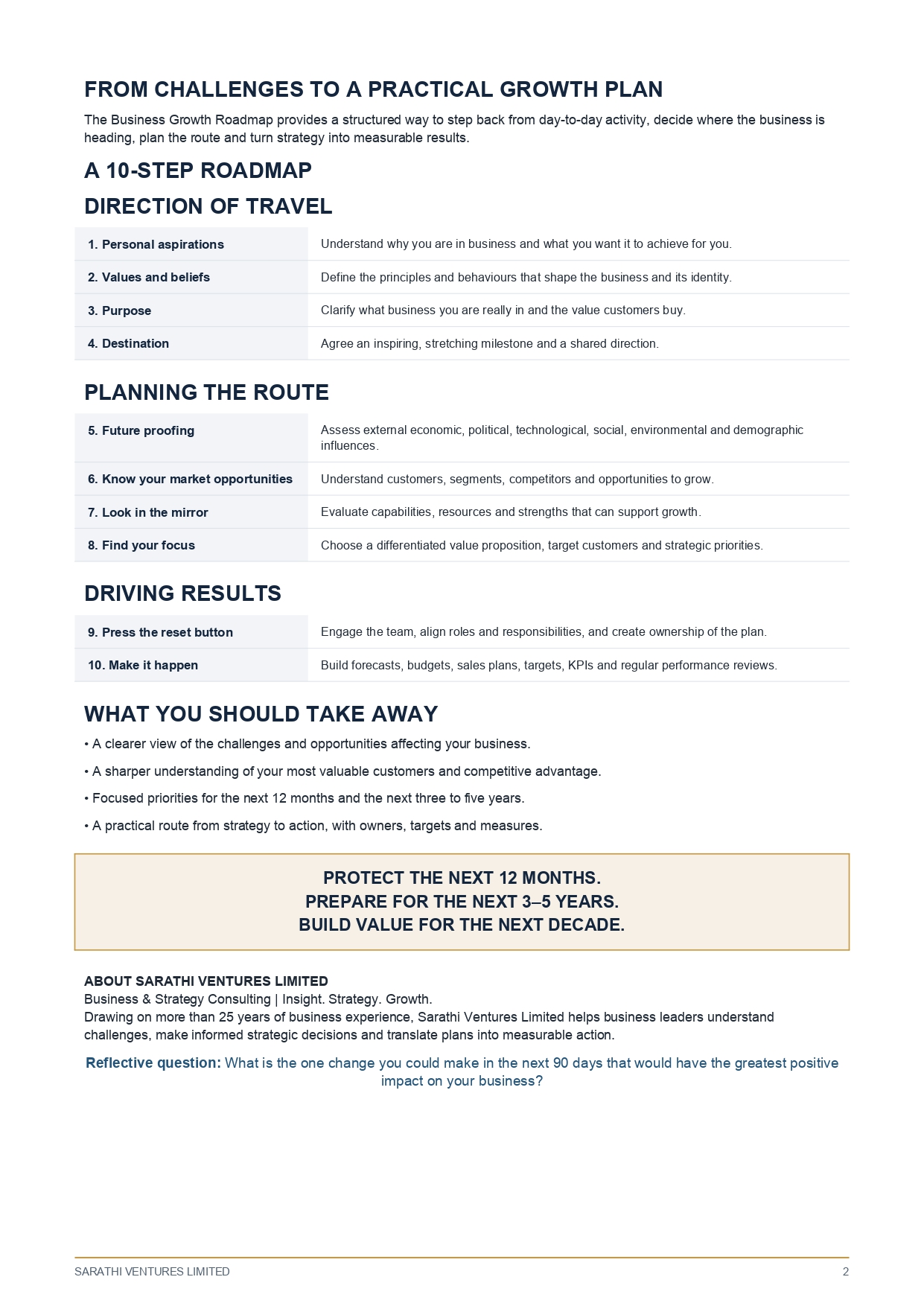
2. The Business Growth Roadmap – Turning challenges into opportunities
Having identified these challenges, the second part of the session will introduce a practical framework to help businesses establish where they want to go, how they intend to get there and how they will measure progress.
The roadmap is structured around three key stages:
A. Direction of Travel
Establishing the foundations for the business:
- Step 1: Personal Aspirations – Understanding why you are in business and what you want to achieve.
- Step 2: Values and Beliefs – Defining the principles and behaviours that shape the business.
- Step 3: Purpose – Understanding what business you are really in and the value you create for customers.
- Step 4: Destination – Establishing a clear and inspiring vision for the future.
B. Planning the Route
Understanding the business environment and identifying the right growth opportunities:
- Step 5: Future Proofing – Assessing external economic, political, technological, social, environmental and demographic influences.
- Step 6: Know Your Market Opportunities – Understanding customers, market segments, competitors and opportunities to grow.
- Step 7: Look in the Mirror – Evaluating internal capabilities, resources and competitive advantage.
- Step 8: Find Your Focus – Defining a differentiated value proposition, target market and clear growth strategy.
C. Driving Results
Turning strategy into action and measurable performance:
- Step 9: Press the Reset Button – Engaging the team, aligning people and responsibilities, and creating ownership of the strategy.
- Step 10: Make It Happen – Developing financial forecasts, budgets, sales plans, targets, KPIs and regular performance reviews.
3. What participants should take away
The objective is not simply to discuss the challenges facing businesses, but to encourage participants to take a step back from day-to-day operations and think strategically about their future.
By the end of the session, participants should have a clearer understanding of:
- The key challenges and opportunities affecting their businesses.
- Their personal and business aspirations.
- Their most valuable customers and market opportunities.
- Their competitive advantage and areas requiring improvement. The priorities that should form their growth strategy.
- How to translate their strategy into financial targets, action plans and measurable results.
I would also like to make the session interactive, encouraging participants to share their experiences, challenges and ideas. The diversity of businesses in the room should provide an opportunity for peer-to-peer learning and practical discussion.
Kindly send me top three priorities and challenges you have or are facing to make session more interactive.
My overall message is:
Protect the next 12 months. Prepare for the next three to five years. Build value for the next decade.
Sustainable business growth is a journey, not a sprint. It requires a clear vision, the right people, a focused strategy and the discipline to measure and deliver results.
I look forward to an engaging and valuable session on Wednesday 2nd December 2026.